Noten edition dohr

Bücher

Tonträger

fermate

Service

e-mail
home

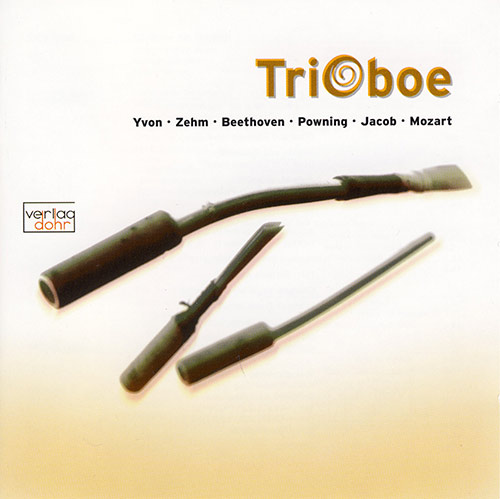
Trioboe

Aufgenommen in der ev. Emmanuelkirche
zu Köln-Rondorf 13. bis 17. 10. 1999
Bestell-Nummer: DCD 003

Preis: EURO 18,50

Tonmeister: Georg Bongartz
Text: Gerhard Anders
Übersetzung: Frances Wharton
Fotograf: Frank Struck
Grafik: Günter Kreß, Köln
Mit freundlicher Unterstützung von
Bollig&Kemper, Lackfabrik zu Köln

Ina Stock * Oboe und Englisch Horn
Thekla von Dombois * Oboe und Englisch Horn
Anja M. Schmiel * Oboe, Englisch Horn und Baritonoboe

Text in english

Carlo Yvon: Capriccio per Tre Oboi

1. Allegro molto vivace 2.22
2. Adagio sostenuto 4.02
3. Primo Tempo 4.47

Friedrich Zehm: Hindemith-Variationen

6 Veränderungen über die II. Variation aus dem „Philharmonischen Konzert" von Paul Hindemith für zwei Oboen und Engl. Horn

4. Einleitung, Lento 1.14
5. Thema, sehr ruhig 1.25
6. Veloce (1. Variation) 0.54
7. Allegro marcato (2. Variation) 1.26
8. Lento espressivo (3. Variation) 2.39
9. Capriccio und Monolog (4. und 5. Var.) 2.41
10. Finale. Vivace (6. Variation) 3.06

Ludwig van Beethoven: Trio C-Dur op. 87

für zwei Oboen und Englisch Horn

11. Allegro 9.55
12. Adagio 4.21
13. Menuetto. Allegro molto. Scherzo 2.22
14. Finale. Presto 3.47

Graham Powning: Trio No. 1

for two oboes and cor anglais

15. Allegro con precisione 1.18
16. Lento e tranquillo 1.52
17. Vivo 0.32

Gordon Jacob: Two Pieces

for two oboes and cor anglais

18. Adagio doloroso 2.57
19. Allegro 2.53

Wolfgang A. Mozart: Divertimento F-Dur

20. Allegro 2.13
21. Adagio 2.41
22. Menuetto 4.22
23. Adagio 1.37
24. Allegro 1.52

total 68.03


Trioboe

The three congenial musicians making up the ensemble TriOboe studied together at the Musikhochschule in Cologne under Professors Helmut Hucke and Christian Schneider. All three of them passed their final examination with distinction. After that, Ina Stock studied further with Michael Niesemann and obtained her "Konzertexamen", while Anja Schmiel and Thekla von Dombois completed their training abroad, doing postgraduate studies with Celia Nicklin at the Royal Academy of Music in London.

Besides playing trios together, all three instrumentalists have solo engagements and are active in other diverse ensembles. The spectrum of these activities ranges from early music on historical instruments to classical chamber orchestral playing and on to jazz, new music, improvisations and contemporary music theatre.

The ensemble have toured England, Austria and the Netherlands and Belgium, where they participated in the Notamus competition with the premiere of a work specially written for TriOboe. Since then further works have been composed for the group including "Cuirtimichioll" (1992) by the Cologne composer, Ulrich Wagner.

Since their foundation in 1989, TriOboe have aimed at exploring the diversity of the repertoire open to them, to add new works and to bring the extraordinary homogeneity of sound of the whole oboe family (oboe, oboe d'amore, cor anglais and bass oboe) in concert to the ears of the public.


The history of music and the evolution of musical instruments are inextricably intertwined. In earlier times, when playing "new" music was a matter of course and the music world of the day and contemporary music were more or less concurrent, a healthy dialogue existed between the technical demands placed on the musicians and the continual refinement of the instruments to meet those demands. One aspect of this development was the formation of "families": for example, the recorders, shawms and viols. These and many others only achieved perfection once the set of instruments from soprano down to bass was complete, producing a perfectly even sound throughout the registers. This was no accident but reflected the ideal model of the consort, which in itself can be seen as an audible image of a closed, consistent world before the Age of Enlightenment. Not until the advent of the modern, "enlightened" orchestra, with its tendency towards diversification, greater colour and heterogeneity of sound, did this old, established order finally break down.

The oboe too is a "family instrument": Besides the oboe in C, we have - since the baroque epoch - the oboe d'amore (in A), so beloved of J. S. Bach, as well as the oboe da caccia (in F) that - despite some misleading terminology - is the predecessor and equivalent of the cor anglais. Finally, on the bass line comes the seldom used bass oboe (also in C). In 1874 Richard Wagner is said to have approached the instrument maker Wilhelm Heckel, bewailing the lack of a full-toned, penetrating bass instrument of the double-reed family for romantic orchestral music. This led to the invention of the heckelphone, which was never actually used by Wagner but was given at least one significant part in Richard Strauss' opera "Salome".

The refinement of the oboe to the level of a solo and chamber music instrument with its own distinctive character first came about in France. The two makers Jean Hotteterre and Michel Danican, who were already making oboes in the 1650s are regarded as the inventors of the instrument. Members of the Grande Ecurie du Roi at Louis XIV's Palace of Versailles, formed an ensemble known as the Douze Grands Hautbois, to which musicians such as André Danican Philidor (grandson of Michel Danican), the Chédeville brothers and Jacques Hotteterre (grandson of Jean Hotteterre) belonged. In the course of the 18th century, the tradition of oboe playing spread from Paris to other cities such as Prague, although most of the oboists from

Prague, if they were serious about pursuing a career, ended up sooner or later in the Imperial city of Vienna. The most famous of these were Georg and Josef Triebensee, Xaver Czerwenka, Johann Nepomuk Went, and the brothers Johann, Franz and Philipp Teimer. And all of them were kept busy, since the Viennese public never tired of convivial music for wind ensembles. The Emperor Joseph II himself was no exception: He set up his own court ensemble, the "Kaiserlich-Königliche Harmonie" expressly for this purpose.

From the scores of the great classic Viennese composers and their contemporaries it is possible to trace the development of oboe playing in the decades leading up to and following 1800. Changes in its construction and mechanical improvements gave the oboe a greater range and facility, enabling it to finally assume the role of a versatile and colourful solo instrument. It is therefore no accident that in the Italian music of Rossini's day, when cantabile quality and virtuosity held real cult status, the oboe was given especially exposed passages. Think of so many of the great opera solos or the concertos of Donizetti and Bellini for oboe or cor anglais.


Carlo Yvon

Capriccio per Tre Oboi (between 1835 and 1850)

The Milanese musician Carlo Yvon (1798 - 1854) was a leading exponent of Italian oboe playing and also a typical representative of the romantic virtuoso period: An absolute master of his instrument, he enjoyed the privilege of being able to pursue his career not in the narrow confines of the court but as first oboist in a municipal orchestra, namely that of La Scala in Milan. Also characteristic of his times, was the fact that Yvon held the position of "Maestro" at the Milan Conservatory. During the romantic era, the music world became increasingly subject to civic authority. This meant, among other things, that general standards were set for a musical training that were imposed through the teaching at the conservatories. For this reason, Carlo Yvon - once a pupil at the conservatory himself - set the standard for Italian oboe playing. In the framework of his teaching, Yvon wrote several pedagogic works such as the six studies for oboe with piano accompaniment and oboe duets. Even his "Capriccio" carries the express dedication "composto e dedicato a suoi Allievi" (composed and dedicated to his pupils), though to play the piece, the "allievo" would have required perfect finger and breathing technique as well as a mastery of musical phrasing. However, apart from its didactic uses, this piece that lies so well for the oboe brings out almost every special tonal quality that the oboe and oboe ensemble have to offer. Furthermore, to quote a famous remark of Mozart's, "The music sounds "pleasant in the ears", and, as we know, a certain salon smoothness was not considered undesirable. In line with its marking 'Capriccio', the work is a free assembly of sonata and rondo forms with bridge passages, ending in a brilliant coda demanding real professional expertise from the player - "Allievi" or otherwise.

Friedrich Zehm

Hindemith Variationen - Six Variations on the II Movement of the Philharmonic Concerto by Paul Hindemith (1978)

Again perfectly written for the instrument and indeed virtuosic, but a composition of a quite different character, the Hindemith variations composed in 1978 by Friedrich Zehm (born 1923), former pupil of Harald Genzmer, music teacher, editor and winner of the Robert Schuman prize, are a prime example of analytical composing. Zehm's choice of a theme of Hindemith's for this work is no surprise, given that his composing technique and the concept behind it are unmistakably of that school.

Many famous examples could be quoted to show that one and the same theme can inspire the composition of several sets of variations. Take, for instance, Paganini's 24th Caprice for violin solo: This inspired Robert Schumann, Franz Liszt, Johannes Brahms. Sergej Rachmaninov, Boris Blacher and Witold Lutoslawski to diverse flights of fancy on the devilish "Teufelsgeiger" theme. Of course, Paganini had already had the idea of incorporating variations into his caprice, and after that no other composer could resist the urge to follow suit.

Unlike the others, however, in his Hindemith variations Friedrich Zehm takes one particular variation as his theme: The second variation from Paul Hindemith's Philharmonic Concerto, an orchestral work written in 1932. The original form of the theme - the nucleus of Hindemith's own variations - remains unstated, purposefully veiled, leaving an already varied form to assume the position of a new main theme. But not satisfied with that, Zehm goes on to write into his introduction a preliminary version of that new theme: Slowly paced, choral-like chords touch on the thematic and harmonic material of the "actual" theme (i.e. Hindemith's second variation) in advance.

In the rest of the piece, each variation is worked around a particular moment in the theme - an interval, a short sequence of notes, a motif - underlining each time one distinctive musical characteristic.

Variation 1: Veloce, "fleeting": in sixteenth notes throughout; worked chiefly around the first motif of the main theme / Variation 2: Allegro marcato: with typical Hindemith-style intonation; the main structural elements are alternating thirds and fourths / Variation 3: Lento espressivo: the centrepiece of the work; interlaced with rising and falling intervals (sevenths, ninths and tenths) / Variation 4: Capriccio and monologue: built around the dotted rhythm, especially of the accompanying voices in the theme, and recurring seconds and sevenths / Variation 5: Monologue for cor anglais; a paraphrase of the main theme / Variation 6: Finale, Vivace "Veemente", in which all the elements are brought together


Ludwig van Beethoven

Trio for Two Oboes and Cor Anglais in C Major, Op. 87 (ca. 1795)

It began with a 'family trio': On 23 December 1793 the Teimer brothers were playing a concert for the Viennese Society of Musicians and the programme included a serenade by their colleague Johann Nepomuk Went for the previously unknown trio-ensemble of 2 oboes and a cor anglais. Ludwig van Beethoven was inspired by this to compose two works for that same combination of instruments: the variations on the aria "Là ci darem la mano" from Mozart's "Don Giovanni" (WoO 28) and the Trio in C major, op. 87, in four movements. Both works are thought to have been written in 1795, and the variations were performed in 1797 at the National Theatre in Vienna by the Prague oboists, Czerwenka, Reuter and Johann Teimer, in a benefit concert to raise funds for widows and orphans.

When Beethoven embarked on the writing of his wind trio in the mid-1790s he was probably following the same strategy that had led him to adopt other popular compositional forms of the day. Always keen to emulate his great role models Mozart and Haydn, but with an unrelentingly systematic approach, he applied himself step by step to those standard compositional forms that promised the greatest success with the audience but which would also display his develop-ing skills as a composer: The piano sonata, piano trio, string trio, string quartet, and finally the symphony - but, characteristically, not until Haydn had elected to vacate the symphonic stage. Most certainly, chamber music for wind ensembles, in comparison to the more "serious" string quartet would have been regarded by the audiences of the day as a lighter, less testing form of musical entertainment. With what sovereignty Beethoven mastered this métier without denying himself the freedom to display his skill and inventiveness in thematic development, is shown in the introductory remarks to the oboe trio, which, as Markus Bandur writes, "betray stylistic aims not normally found in wind music of the second half of the 18th century." (1) Beethoven valued the trio highly enough to consider it still worth printing by Artaria in 1806, which is how it came to be given its misleadingly high opus number.

In this context, a review of the work that appeared in 1808 in the Allgemeine Musikalische Zeitung is quite revealing, and indicates, in a somewhat backhanded way, that his contemporaries shared his opinion: "Under whatever conditions and at whatever period this little work may have been written, we find that it has no little value. It is a merry scene, tossed off by a light but skilled and expert hand [...] it contains no bold or uplifting thoughts but is pleasing, and the way it is put together makes a pretty enticing piece. Here you find no disparity, nothing contrived or unnatural. Thus it manages, by all the skills applied, to provide a pleasant and untroubled, if not elevated pleasure." The review goes on to say that the trio requires "...to achieve its full effect, expert players, who know how to perform their parts with taste and nicety." (2).


Graham Powning

Trio No. 1 for Two Oboes and Cor Anglais (1972)

Humour and esprit, cantabile phrases and an obvious penchant for rhythmic finesse are the essential characteristics of the three movements of the Trio No. 1, composed by Graham Powning in 1972. The Australian composer, born in 1949, started playing the flute as an eight-year-old boy and transferred to oboe at the age of thirteen. Since 1971 Powning has been a teacher himself at his former college, the New South Wales Conservatory and was Solo Oboist with the Sydney Opera orchestra from 1972 to 1985. He also gives solo and chamber-music concerts and has composed a large number of works on the side, mostly chamber music for woodwinds. Owing to its brevity, Powning's Trio No. 1 cannot be regarded as a full opus in the classic sense. Anyone searching for Beethoven-style thematic development in the composition will be disappointed. It is more a kind of musical game, its attraction lying in the idiomatic character of the motifs and phrasing, obviously dictated by the natural qualities of the instrument. Easily recognisable jazz elements give the piece a little extra spice: Already in the leading motif of the "Allegro con precisione" and again in the variations that emerge in the course of the movement - the oboe trio is called upon to transform themselves into a veritable Big Band, and the "Lento e tranquillo" is a straight jazz ballade. All in all, a real divertimento: short, entertaining and absolutely "oboistic".


Gordon Jacob

Two Pieces for Two Oboes and Cor Anglais (1945)

Gordon Jacob (1895 - 1984) was one of the most productive and best-known English composers of recent times. After leaving the Royal College of Music in London, where he studied under the two great choral composers Stanford and Parry, Jacob embarked on his teaching career at Birkbeck College. In 1926 he then returned to the RCM, where he taught for the next forty years. The workshop of the music pedagogue produced the books Orchestral Technique (1931), The Composer and his Art (1960) and a title that became particularly popular in England - How to read a Score (1944).

Jacob left a wide-ranging Oeuvre behind him, including countless solo and chamber-music works for wind. Faultless technical skill and a brilliant understanding of the instruments for which he was writing are combined in many of these works with his great sense of humour and esprit, as they are in the Two Pieces of 1954. These form a contrasting pair: The first movement (A minor) has a solemn character and is aptly marked Adagio doloroso. Its distressing and highly expressive air are a good reminder that - contrary to some continental misconceptions - British music has more to offer than noblesse, "pomp" and "circumstance". Then suddenly the mood changes and an Allegro giocoso (A major) is tumbled out in a thoroughly jovial manner, with a few more meditative notes appearing in a short D-major interlude.


Wolfgang Amadeus Mozart

Divertimento in F Major from K. 439b (1783) with the Adagio in F Major K. 410 (1785) (arranged for two cors anglais and bass oboe)

This work brings us back to 18th-century Vienna, to the court of Joseph II and to the ensemble "Kaiserlich-Königliche Harmonie". By all accounts Mozart was never accepted into the circle of the Emperor's wind players, although his most important wind serenades were written with this ensemble in mind. As far as is known, none of Mozart's music for wind was ever performed at the court. He did however become close friends with some of the musicians employed there. Less with the oboist Went, who apparently pulled the carpet out from under Mozart's feet with his own arrangement for wind of popular melodies from "Il Seraglio", than with the clarinettist Anton Stadler. Far removed from the official music circles of Vienna, Mozart appears here in an unfamiliar guise: that of the passionate experimenter.

It seems possible, suggests Wolfgang Hildesheimer, "that in some hours of his musical private life between 1783 and 1785, Mozart threw himself with gusto into playing with different constellations of wind instruments; and this in a hectic time when he would have had to literally "steal" days or, more likely, nights for Stadler to bring round a few pals to rehearse the five Divertimenti for wind (K. 439b), probably in various combinations. Instruments were exchanged - clarinet or basset horn, basset horn or bassoon? - until they presumably agreed on three basset horns. These experiments that may well have had no particular purpose but were simply carried out for the enjoyment of this productive game, played again and again with different players in various combinations. Out of them, towards the end of 1785, came the mysterious five pieces for winds (K. 484a-e), [...] short, fragmentary strokes of genius, including 27 bars for two basset horns and bassoon (K. 484d), like a note dashed off in a particularly joyful moment..."(3)

There is no documentary evidence that Hildesheimer's imagined scene from Mozart's private life ever came to pass. However, the vignette may well be close to the truth. And what could capture the spirit of these "experimental" works better than to hear them once in the novel timbre of other instruments? Here the F Major Divertimento from K. 439b and the inserted movement, the Adagio in F Major K. 410 (i.e. K. 484d) can be heard in a version for two cors anglais (the tenor instrument of the oboe family, corresponding to the basset horns in their 'family') and bass oboe. In the version of the Mozart Divertimento played by TriOboe, the latter instrument represents the lowest of the three basset horn voices, while in the inserted Adagio it takes the part of the bassoon.

Gerhard Anders/translation: FrancesWharton

Trioboe

Die drei "seelenverwandten" Musikerinnen des Ensembles TriOboe studierten zunächst an der Musikhochschule Köln bei Prof. Helmut Hucke und Prof. Christian Schneider. Alle drei erhielten ihre Künstlerische Reifeprüfung „mit Auszeichnung". Anschließend absolvierte Ina Stock ein Aufbaustudium bei Michael Niesemann, das sie mit dem Konzertexamen abschloss, während Anja Schmiel und Thekla von Dombois ihre Ausbildung durch ein Auslandsstudium bei Celia Nicklin an der Royal Academy of Music in London vervollkommneten.

Neben dem gemeinsamen Triospiel stehen solistische sowie vielfältige Ensemble-Aktivitäten im Zentrum ihrer Arbeit. Das Spektrum reicht von Alter Musik auf historischen Instrumenten bis hin zu Jazz, Neuer Musik, Improvisierter Musik und Neuem Musiktheater.

Konzertreisen führten das Ensemble u.a. nach England, Österreich, in die Niederlande und nach Belgien, wo im Rahmen des Notamus-Wettbewerbs erstmals die Uraufführung einer für TriOboe geschriebenen Komposition stattfand. Seither wurden weitere Werke für das Ensemble komponiert, darunter "Cuirtimichiol" (1992) des Kölner Komponisten Ulrich Wagner.

Seit seiner Gründung im Jahr 1989 hat sich TriOboe zum Ziel gesetzt, die Vielfalt des vorhandenen Repertoires auszuloten, neue Werke zu erschließen und dabei die außergewöhnliche klangliche Homogenität der gesamten Oboen- „Familie" (Oboe, Oboe d'amore, Englisch Horn und Baritonoboe) hörbar zu machen.


Musikhistorie und Geschichte der Musikinstrumente sind nicht voneinander zu trennen. In früheren Jahrhunderten, als es eine Selbstverständlichkeit war, "Neue Musik" zu spielen - musikalische Gegenwart und Gegenwartsmusik stimmten noch weitgehend überein -, bestand eine Art Dialogverhältnis zwischen wachsenden musikalisch-technischen Anforderungen und ständiger Optimierung der Instrumente. Ein Charakteristikum dieser Entwicklung waren die "Familien": Blockflöten, Pommern, Violen, sie und viele andere hatten ihre "perfectio" erst erreicht, wenn der gesamte vollstimmige Satz von der Sopran- bis zur Basslage in einheitlicher Klangfärbung zur Verfügung stand. Dies war kein Zufall, sondern entsprach dem Stilideal des Consorts, das wiederum als klingendes Abbild einer geschlossenen, homogenen Welt der Vor-Aufklärung bezeichnet werden mag. Erst das moderne, "aufgeklärte" Orchester mit seiner Tendenz zur Diversifizierung, zu mehr Farbigkeit und Heterogenität des Klanges, brachte diese "alte Welt" zum Einsturz.

Auch die Oboe ist ein "Familieninstrument": Neben der in C notierten Oboe kennen wir seit der Barockzeit vor allem die von J. S. Bach geschätzte Oboe d'amore (in A), weiterhin die Oboe da caccia (in F) - die wohl, terminologischen Unklarheiten zum Trotz, mit dem ebenfalls in F notierten Englisch Horn gleichzusetzen ist - sowie als Bassinstrument die selten verwendete (ebenfalls in C notierte) Baritonoboe. Bekanntlich hat Richard Wagner noch 1874 dem Instrumentenmacher Wilhelm Heckel sein Leid geklagt über den Mangel eines klangstarken, durchsetzungsfähigen Bariton-Instruments der Doppelrohrblattfamilie innerhalb des romantischen Orchesters. Dies führte zur Erfindung des Heckelphons, das zwar von Wagner selbst nicht mehr eingesetzt wurde, dafür wenig später in Richard Strauss' "Salome" zumindest eine Paradepartie des Opernrepertoires erhielt.

Die Perfektionierung der Oboe zum Solo- und Kammermusikinstrument neuerer Prägung vollzog sich zunächst in Frankreich. Als ihre eigentlichen Erfinder gelten Jean Hotteterre und Michel Danican, die schon in den 1650er Jahren Oboen bauten. Mitglieder der Grande Ecurie du Roi am Versailler Hof Ludwigs XIV. bildeten die Gruppe der sogenannten Douze Grands Hautbois, zu der Musiker wie André Danican Philidor (Enkel Michel Danicans), die Brüder Chédeville und Jacques Hotteterre (Enkel Jean Hotteterres) gehörten. Ausgehend von Paris entstanden im Laufe des 18. Jahrhunderts an anderen Orten bedeutende Oboentraditionen, so etwa in Prag, wobei es allerdings zahlreiche Prager Oboisten, die Karriere machen wollten, früher oder später in die Kaiserstadt Wien zog: Die berühmtesten unter ihnen waren Georg und Josef Triebensee, Xaver Czerwenka, Johann Nepomuk Went, schließlich die Brüder Johann, Franz und Philipp Teimer. Und alle waren sie gut im Geschäft, denn das Wiener Publikum konnte sich damals nicht satt hören an geselliger Bläsermusik. Kaiser Joseph II. selbst machte hierin keine Ausnahme, ja er schuf sich mit der "Kaiserlich-Königlichen Harmonie" sogar ein eigenes Hofensemble für diese Zwecke.

Anhand der Partituren der Wiener Klassiker und ihrer Zeitgenossen lässt sich nachvollziehen, welche Entwicklung das Oboenspiel in den Jahrzehnten vor und nach 1800 nahm. Flankiert von Veränderungen in Bauweise und Mechanik, die der Erweiterung des Tonumfangs sowie größtmöglicher Geläufigkeit dienen sollten, wuchs die Oboe endgültig in die Rolle eines vielseitigen, facettenreichen Soloinstruments. So kommt es nicht von ungefähr, dass sie in der italienischen Musik der Rossini-Zeit - Kantabilität und Virtuosität besaßen hier geradezu Kultstatus - besonders exponierte Aufgaben erhielt. Man denke an so manch großes Opern-Solo ebenso wie an Donizettis und Bellinis Concerti für Oboe bzw. Englisch Horn.


Carlo Yvon

Capriccio per Tre Oboi (zwischen 1835 und 1850)

Der Mailänder Carlo Yvon (1798-1854) war ein Hauptexponent italienischer Oboenkunst und darüber hinaus typischer Vertreter der romantischen Virtuosenzeit: Als perfekter Meister seines Instruments genoss er das Privileg, seinen Beruf nicht mehr in der Enge eines Hofstaates, sondern als 1. Oboist eines "bürgerlichen" Orchesters - desjenigen der Mailänder Scala - ausüben zu können. Ebenso charakteristisch für seine Zeit ist freilich, dass Yvon als "Maestro" am Konservatorium von Mailand wirkte: Die Romantik war eine Epoche der zunehmenden Verbürgerlichung des Musiklebens. Dazu gehörte, dass die musikalische Ausbildung allgemein geltenden Standards unterworfen wurde, die durch den Unterricht an den Konservatorien gesetzt wurden. Insofern dürfte Carlo Yvon - selbst einst Schüler des Conservatorio - für viele italienische Oboisten maßstabsetzend gewirkt haben.

Im Rahmen seiner Lehrtätigkeit schrieb Yvon einige pädagogisch orientierte Werke, z.B. Sechs Studien für Oboe mit Klavierbegleitung sowie Oboenduette. Auch sein "Capriccio" trägt die ausdrückliche Widmung "composto e dedicato a suoi Allievi" ("komponiert und gewidmet seinen Schülern"), doch sollte der "Allievo" durchaus über eine perfekte Finger- und Atemtechnik sowie über musikalische Gestaltungskraft verfügen. Jenseits aller "Didaktik" bringt dieses dankbar zu spielende Werk viele klangliche Vorzüge der Oboe und des Oboenensembles zur Geltung. Die Musik geht überdies - um ein berühmtes Mozart-Wort zu zitieren - "angenehm in die Ohren", wobei eine gewisse salonhafte Glätte gern in Kauf genommen wird. Der Bezeichnung 'Capriccio' entsprechend, präsentiert sich das Werk als frei gestaltete Verknüpfung von sonaten- und rondoartigen sowie freien Überleitungspassagen, mündend in einen brillanten Schluss-abschnitt, der den Spielern - ob "Allievi" oder nicht - wahrhaft professionelles Können abverlangt.


Friedrich Zehm

Hindemith-Variationen - Sechs Variationen über die II. Veränderung aus dem "Philharmonischen Konzert" von Paul Hindemith (1978)

Nicht weniger instrumentengerecht, ja virtuos gesetzt, kompositorisch freilich aus ganz anderem Holz, präsentieren sich die 1978 entstandenen Hindemith-Variationen des ehemaligen Harald Genzmer-Schülers, Musiklehrers, Verlagslektors und Robert-Schumann-Preisträgers Friedrich Zehm (geb. 1923) als Musterbeispiele analytischer Kompositionstechnik. Dass Zehm hierfür ein Hindemithsches Thema gewählt hat, ist insofern "Programm", als sein Komponieren handwerklich und gedanklich unüberhörbar dessen Schule entstammt.

An berühmten Beispielen lässt sich belegen, dass ein und dasselbe Thema durchaus mehrfach zum Variieren anregen kann. So etwa an Paganinis 24. Caprice für Violine-Solo: Sie inspirierte unter anderem Robert Schumann, Franz Liszt, Johannes Brahms, Sergej Rachmaninow, Boris Blacher und Witold Lutoslawski zu mehr oder weniger phantastischen Exkursen über das "teufelsgeigerische" Thema. Freilich hatte Paganini selbst in seiner Caprice diesen Einfall bereits einem Variierungsprozess unterworfen, auf den alle nachfolgenden Komponisten in ihrer Durchleuchtung des Themas zwangsläufig auch Bezug nahmen.

Im Gegensatz dazu rekurriert Friedrich Zehm in seinen Hindemith-Variationen unmittelbar auf eine 'Variation als Thema': die Zweite Veränderung aus Paul Hindemiths "Philharmonischem Konzert", einem Orchesterwerk aus dem Jahr 1932. Die Urgestalt des Themas - Keimzelle von Hindemiths eigenen Variationen - bleibt also unbekannt, sie wird bewusst verschleiert, um eine bereits variierte Form gleichsam in den Zustand einer neuen Urgestalt zu versetzen. Damit nicht genug, suggeriert Zehm in der Einleitung noch eine Art Vorform der neuen Urgestalt: Choralartige Akkorde in langsam schreitender Bewegung lassen das thematische und harmonische Material des "eigentlichen" Themas (d.h. der Hindemithschen Zweiten Veränderung) bereits anklingen.

Im folgenden behandelt jede einzelne Variation ein bestimmtes Einzelmoment des Themas - ein Intervall, eine kurze Tonfolge, einen Motivgestus - und verknüpft hiermit die Darstellung einer ausgeprägten musikalischen Charakteristik:

1. Variation - Veloce, "flüchtig", durchweg in Sechzehntelbewegung; insbesondere der erste motivische Gedanke des Themas wird verarbeitet;

2. Variation - Allegro marcato, in durchaus "Hindemithschem" Tonfall; Haupt-Strukturelement sind Terzen und Quarten in Wechselnotenbewegung;

3. Variation - Lento espressivo, Zentrum des Werks; strukturbildend ist hier der große Intervallsprung (Septime, None, Dezime), auf- und abwärts;

4. Variation - Capriccio und Monolog; der punktierte Rhythmus (insbesondere der Begleitstimmen des Themas) sowie die Umkehrungsintervalle Sekunde und Septime werden hier zum Ausgangsmaterial;

5. Variation - Monolog des Englisch Horns; eine Art Themenparaphrase;

6. Variation - Finale. Vivace "veemente"; alle Element werden zusammengefasst.


Ludwig van Beethoven

Trio für zwei Oboen und Englisch Horn C-Dur op. 87 (ca. 1795)

Es begann mit einem "Familientrio": Am 23. Dezember 1793 spielten die Gebrüder Teimer in einem Konzert der Wiener Tonkünstler-Sozietät unter anderem eine Serenade ihres Kollegen Johann Nepomuk Went für die bis dahin "unerhörte" Trio-Besetzung aus zwei Oboen und Englisch Horn. Ludwig van Beethoven wurde hierdurch angeregt, zwei Werke für dieselbe Besetzung zu komponieren: die Variationen über "Là ci darem la mano" aus Mozarts "Don Giovanni" (WoO 28) sowie das viersätzige Trio C-Dur op. 87. Beide Werke entstanden vermutlich 1795, die Variationen wurden 1797 im Wiener Nationaltheater von den "Ex-Pragern" Czerwenka, Reuter und Johann Teimer in einem Konzert zugunsten der Witwen und Waisen aufgeführt.

Vermutlich verfolgte Beethoven, als er sich um die Mitte der 1790er Jahre dem Bläsertrio zuwandte, eine ähnliche "Strategie" wie im Falle anderer, zu dieser Zeit beliebter Kompositionsformen: Stets den großen Vorbildern Mozart und Haydn nacheifernd und doch mit unerbittlicher Systematik erschloss er sich Zug um Zug jene Gattungen, die einerseits die größten Publikumserfolge versprachen, andererseits aber als Prüfsteine der kompositorischen Entwicklung galten: Klaviersonate, Klaviertrio, Streichtrio, Streichquartett, schließlich - bezeichnenderweise erst nach Haydns "Abdankung" - auch die Sinfonie. Gewiss stand Bläserkammermusik, verglichen etwa mit dem "seriösen" Streichquartett, beim damaligen Publikum in dem Ruf, leichte, problemlose Unterhaltungsmusik zu bieten. Wie souverän Beethoven auch dieses Metier beherrschte, ohne auf die ihm eigene Kunst motivisch-thematischer Durchführungsarbeit zu verzichten, beweist insbesondere der Kopfsatz seines Oboentrios, der, wie Markus Bandur formuliert, "deutlich die Orientierung an einer Stilhöhe erkennen [lässt], die der Bläsermusik in der zweiten Hälfte des 18. Jahrhunderts nicht eigen war." (1) Immerhin hielt Beethoven das Trio noch 1806 für wert, es bei Artaria drucken zu lassen. Hierdurch erhielt es seine irreführend hohe Opuszahl.

Aufschlussreich ist in diesem Zusammenhang eine Besprechung des Werks, die 1808 in der Allgemeinen Musikalischen Zeitung erschien. Berücksichtigt man gewisse Eigenheiten der sprachlichen Diktion, so scheinen auch die Zeitgenossen zu einem ähnlichen Urteil gekommen zu sein: "Unter welchen Verhältnissen und zu welcher Zeit nun auch dieses Werkchen geschrieben seyn mag, so finden wir doch, dass es keinen geringen Werth hat; es ist ein mit leichter, aber geschickter, fertiger Hand hingeworfenes heiteres Gemälde, [...] das keine kühnen, erhabenen Gedanken enthält, aber angenehme, und das, wie alles nun zusammengestellt ist, ein anziehendes Ganzes ausmacht. Man bemerkt nirgends ein Missverhältnis, nirgends etwas Gesuchtes oder Unnatürliches; daher verschafft es, bey aller angewandten Kunst, einen angenehmen, ungetrübten, wenn auch nicht hohen Genuss." Weiterhin heißt es, das Trio erfordere "...wenn es seine Wirkung thun soll, fertige Spieler, die auch ihre Stimmen mit Geschmack und Nettigkeit vorzutragen wissen." (2)


Graham Powning

Trio Nr. 1 for Two Oboes and Cor Anglais (1972)

Witz und Esprit, Kantabilität und - nicht zu vergessen - ein ausgesprochenes Faible für rhythmische Finessen sind wesentliche Merkmale des dreisätzigen Trios Nr. 1 aus dem Jahr 1972 von Graham Powning. Der australische Komponist, Jahrgang 1949, begann achtjährig mit dem

Flötenspiel, bevor er als Dreizehnjähriger zur Oboe wechselte. Seit 1971 unterrichtet Powning selbst an seiner ehemaligen Ausbildungsstätte, dem New South Wales Conservatorium, und von 1972 bis 1985 war er Solo-Oboist am Orchester der Oper von Sydney. Er tritt als Solist und Kammermusiker auf und hat daneben eine große Zahl von Kompositionen vorgelegt, in erster Linie Kammermusik für Holzbläser.

Pownings Trio Nr. 1 lässt sich schon aufgrund seiner Kürze kaum als "ausgewachsenes Opus" im klassischen Sinne kennzeichnen. Durchführungsarbeit à la Beethoven wird man vergeblich suchen, eher handelt es sich um eine Spielmusik, deren Reiz in ihrer Idiomatik, in der spürbar vom Instrument her gedachten Linienführung und Motivik liegt. Deutlich vernehmbare Jazz-Anklänge geben zusätzliche "Würze": Schon im Kopfmotiv des "Allegro con precisione" - und mehr noch in den Varianten, die im Laufe des Satzes erscheinen - ist das Oboentrio aufgerufen, sich in eine veritable Bigband zu verwandeln, und das "Lento e tranquillo" ist eine mustergültige Jazz-Ballade. Alles in allem: ein echtes Divertimento, knapp, unterhaltsam, sehr "oboistisch".


Gordon Jacob

Two Pieces for Two Oboes and Cor Anglais (1954)

Gordon Jacob (1895 - 1984) gehörte zu den produktivsten und bekanntesten englischen Komponisten jüngerer Zeit. Nach seinem Studium am Londoner Royal College of Music - zu seinen Lehrern zählten die großen Romantiker Stanford und Parry - begann Jacob seine Unterrichtslaufbahn am Birkbeck College, bevor er 1926 an das RCM zurückkehrte, wo er bis 1966 als Lehrer wirkte. Der Werkstatt des Musikpädagogen Jacob entstammen die Bücher "Orchestral Technique" (1931), "The Composer and his Art" (1960) sowie - in England zu besonderer Popularität gelangt - "How to read a Score" (1944).

Jacob hinterließ ein umfangreiches Œuvre, darunter zahlreiche solistische und kammermusikalische Werke für Bläser. Makellose technische Faktur und brillante, instrumentengerechte Schreibweise verbinden sich in vielen dieser Werke mit Sinn für geistreiche musikalische Unterhaltung, so auch in den Two Pieces aus dem Jahr 1954. Sie bilden ein kontrastierendes Satzpaar: Der erste Satz (a-moll) ist von getragenem Charakter und trägt zu Recht die Bezeichnung Adagio doloroso. Sein schmerzlich-expressiver Gestus erinnert daran, dass - entgegen manchem "kontinentalen" Vorurteil - die Musik der Briten durchaus nicht nur aus edler Noblesse, "Pomp" und "Circumstance" besteht. Dann schlägt die Stimmung plötzlich um, und in ausgesprochen vergnüglicher Manier wirbelt ein Allegro giocoso (A-Dur) über die Szene, das sich lediglich im kurzen D-Dur-Mittelteil einige besinnlichere Töne gönnt.


Wolfgang Amadeus Mozart

Divertimento F-Dur aus KV 439b (1783) mit Einlage-Adagio F-Dur KV 410 (1785; bearbeitet für zwei Englisch Hörner und Baritonoboe)

Mit diesem Werk kehren wir zurück in das Wien des 18. Jahrhunderts, an den Hof Josephs II. und damit auch zur "Kaiserlich-Königlichen Harmonie". Offensichtlich ist es Mozart nie gelungen, im Kreis der Josephinischen Bläser Fuß zu fassen, wenngleich seine bedeutendsten Bläser-serenaden im Hinblick auf dieses Ensemble entstanden. Soweit bekannt, wurde keine der Mozartschen Harmoniemusiken je bei Hofe aufgeführt. Mit einigen der dort beschäftigten Musiker pflegte Mozart gleichwohl enge Kontakte. Weniger mit dem Oboisten Went, der offensichtlich durch sein eigenes Bläser-Arrangement beliebter Melodien aus der "Entführung aus dem Serail" Mozart bei Hofe "das Wasser abgegraben" hatte, als vielmehr mit dem Klarinettisten Anton Stadler. Fernab vom "offiziellen" musikalischen Wien zeigte sich Mozart hier von einer weniger bekannten Seite: als leidenschaftlicher Experimentator.

Es scheint, so vermutet Wolfgang Hildesheimer, "als habe [Mozart] in mancher Stunde seines musikalischen Privatlebens von 1783 bis 1785 in der Zusammenstellung bestimmter Bläserkombinationen geradezu geschwelgt; und dies in einer hektischen Zeit, während gleichsam gestohlener Tage und, vor allem vielleicht, Nächte, in denen Stadler ein paar Kumpane mitbrachte, und die fünf Bläser-Divertimenti (KV 439b) geprobt wurden, wahrscheinlich in verschiedenen Kombinationen: Instrumente wurden ausgetauscht - Klarinette oder Bassetthorn, Bassetthorn oder Fagott? -, bis man sich wahrscheinlich auf drei Bassetthörner einigte: Experimente, wahrscheinlich für keine bestimmten Anlässe, sondern aus Lust am schönen, ergiebigen Spiel, immer wieder mit anderen Mitspielern, immer in anderen Zusammenstellungen: Ihm entsprangen, gegen Ende 1785, die geheimnisvollen fünf Bläserstücke (KV 484a-e), [...] kurze, zum Teil fragmentarische Würfe, darunter die 27 Takte für zwei Bassetthörner und Fagott (KV 484d), gleichsam eine Notiz, vielleicht in einigen wenigen glücklichen Minuten entstanden ..." (3)

Hildesheimers imaginierte Szene aus Mozarts Privatleben ist kein Tatsachenbericht, doch kommt sie möglicherweise der Wirklichkeit sehr nahe. Und was entspräche dem "experimentellen" Charakter dieser Werke mehr, als sie einmal im Klang anderer Instrumente zu hören? Hier erklingt das F-Dur-Divertimento aus KV 439b sowie, als Einlagesatz, das Adagio F-Dur KV 410 (i.e. KV 484d) in einer Version für zwei Englischhörner (die Tenorinstrumente der Oboen, entsprechend den Bassetthörnern in ihrer "Familie") und Baritonoboe. Dieses Instrument vertritt in der hier eingespielten Version des Mozart-Divertimentos die tiefste der drei Bassetthornstimmen, im Einlage-Adagio hingegen das Fagott.

Gerhard Anders

(1) Markus Bandur: "Trio C-Dur op. 87 ...", in: A. Riethmüller e.a. (Hrsg.): Beethoven - Interpretationen seiner Werke, Laaber 1994, S. 15 ff.

(2) zitiert nach: Stefan Kunze (Hrsg.): Ludwig van Beethoven - Die Werke im Spiegel seiner Zeit, Laaber 1987, S. 265 f.

(3) Wolfgang Hildesheimer: Mozart, Frankfurt 1977, S. 189

aktualisiert Donnerstag, 14. Dezember 2006
© 1998-2007 by Verlag Christoph Dohr Köln / edition dohr